The AI Capital Reckoning
AI demand is still accelerating, but a higher-rate cycle is forcing investors to separate durable full-stack economics from growth financed by short contracts, expensive debt and uncertain utilization.
The repricing is not a verdict on demand
The AI trade has entered a more demanding phase. On September 16, the Federal Reserve raised the federal-funds target range to 3.75%–4.00%, reversing part of the prior easing cycle while inflation remained elevated. That move does not erase demand for compute, models or coding agents. It does raise the hurdle rate for businesses whose cash outflows arrive years before their capacity is fully utilized.
The result is a split market. Revenue growth and customer commitments can still justify investment, but capital structure now matters as much as product momentum. Equity-funded hyperscalers can tolerate long build cycles. Leveraged infrastructure providers must continuously refinance equipment, power and construction while matching long-lived assets to contracts that may be shorter than the debt raised against them.
Capital is migrating across the stack
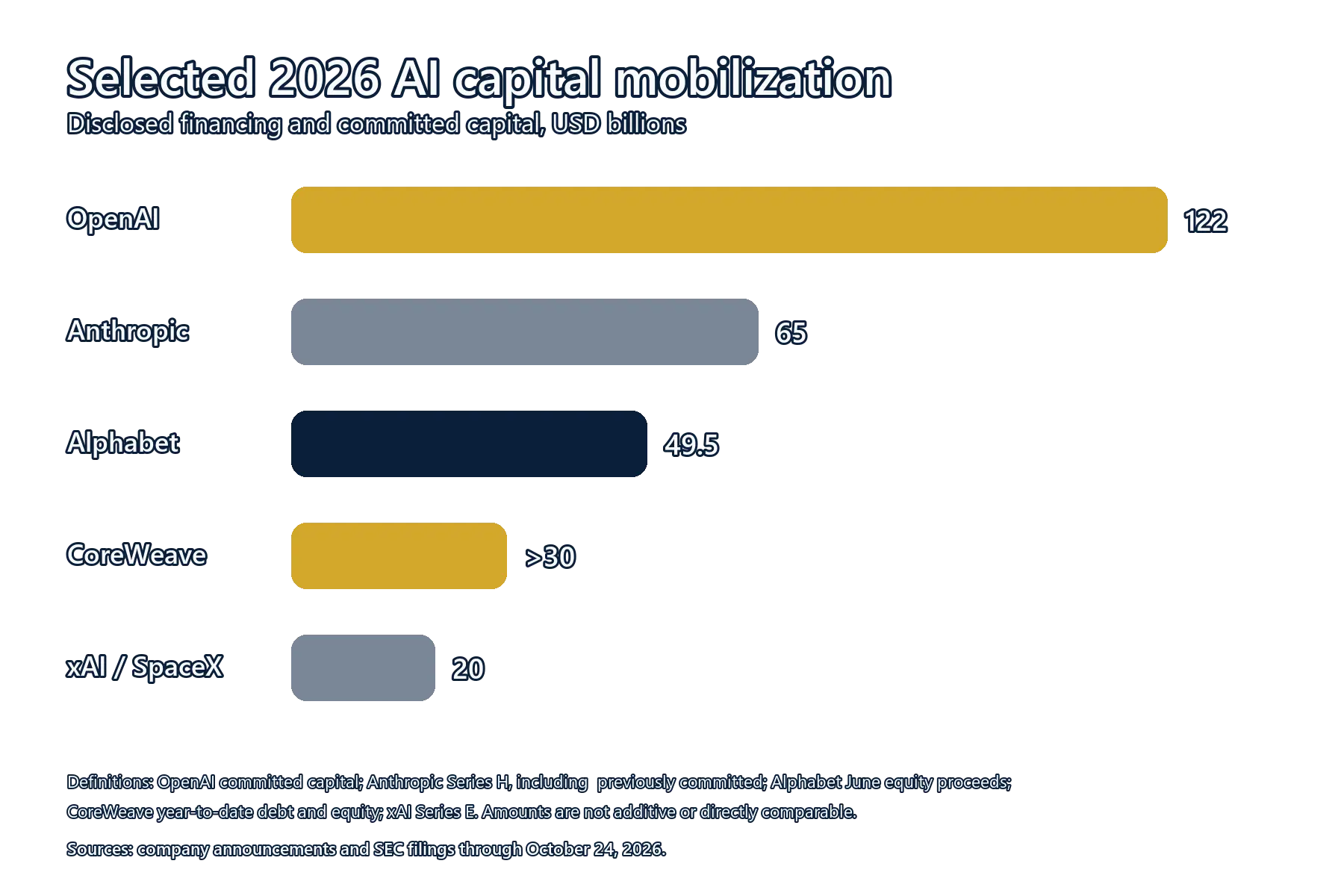
The scale is extraordinary even before adding planned projects. OpenAI closed $122 billion of committed capital at an $852 billion post-money valuation. Anthropic raised $65 billion at a $965 billion post-money valuation, although $15 billion of that amount had been previously committed by hyperscalers. xAI raised $20 billion in January before SpaceX acquired xAI in February, combining infrastructure ambition, a frontier model and distribution assets under one corporate roof.
Public companies are mobilizing comparable sums through different instruments. Alphabet’s June financing produced $49.5 billion of net common, private-placement and mandatory-convertible preferred equity proceeds for general corporate purposes including AI infrastructure and global compute. CoreWeave said it had secured more than $30 billion of debt and equity capital year to date by August 10. These figures are not additive or directly comparable, but they show how quickly the industry is converting expectations about future AI usage into present-day financing.
The public-market test is already visible
Alphabet’s second-quarter revenue rose 24% to $119.8 billion, while Google Cloud grew 82% to $24.8 billion. In the first half of 2026, Alphabet spent $80.6 billion on capital expenditures. That pairing—strong cloud growth alongside a rapidly expanding asset base—is the most constructive version of the AI investment case: monetization is visible before all capacity has arrived.
CoreWeave presents the sharper edge of the same thesis. Its second-quarter update reported roughly $104 billion of backlog, but that measure includes remaining performance obligations and management estimates subject to delivery and availability requirements. The company also raised more than $10 billion of unsecured debt and convertible bonds during the quarter. Demand may be real while refinancing, execution and customer concentration remain material.
For investors, the question is no longer whether AI infrastructure will be built. It is who can finance it through a higher-rate cycle, keep utilization high as models become cheaper, and retain enough pricing power to earn a return after depreciation, power and financing costs.
Disclaimer
This Perspective is for informational purposes only and does not constitute investment advice, an offer, or a recommendation to buy or sell any security. Financing amounts use issuer definitions and are not directly comparable. Forward-looking statements and backlog measures are subject to company-specific assumptions, delivery conditions and risks.